Examqo › Examqo library › Speech-language pathology and audiology › Clinical audiology
ABR and evoked potentials: generators, latencies, neurological and threshold ABR, ASSR, ECochG and late responses
The ABR is a series of waves in the first ten milliseconds after a stimulus, from the auditory nerve to the upper brainstem. It is used in two ways: the neurological ABR (latencies and intervals, for suspected retrocochlear lesions) and the threshold ABR (the lowest level that still gives a wave V, to estimate hearing in infants).
Why it matters in the exam
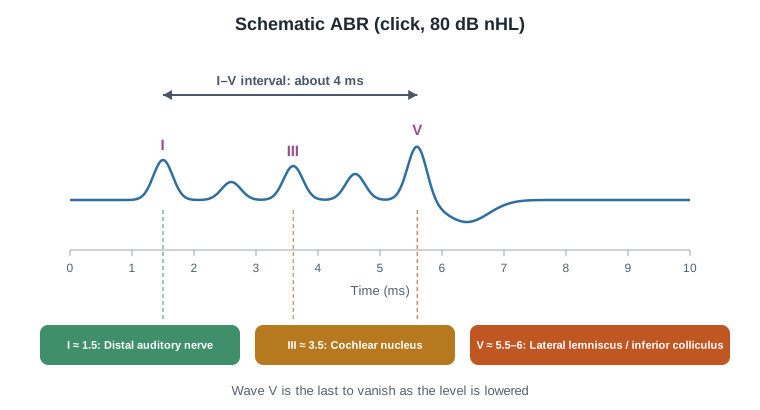
Generators and latencies: wave I — the distal auditory nerve (about 1.5 ms), wave II — the proximal nerve, wave III — the cochlear nucleus (about 3.5), wave V — the lateral lemniscus where it ends in the inferior colliculus (about 5.5–6). A normal I–V interval is about 4 ms. In conductive loss every wave is late and the intervals are normal; in high-frequency cochlear loss wave I is small or late, and wave V is nearly normal at high levels; in a retrocochlear lesion the I–III or I–V interval lengthens, there is an interaural wave V difference (above about 0.4 ms) or a small V/I amplitude ratio. If only wave I is present — this fits brain death, because the cochlea and distal nerve still work. In a newborn wave V is later and the system matures over the first two years. The ABR is unaffected by sleep, so it is recorded in a sleeping infant.
Threshold ABR: start high and step down; wave V is the last to disappear. The unit is dB nHL, and a correction is applied to estimate behavioural threshold — the largest correction at low frequencies. A click mainly reflects 2000–4000 Hz and is not frequency-specific — a child whose loss rises or dips at some frequencies may still show a normal click threshold; so infants are fitted with hearing aids from tone-burst ABR. With tone bursts, a higher frequency gives a shorter latency. A chirp offsets the cochlear delay and gives a larger wave V. Alternating polarity cancels the cochlear microphonic (CM). ASSR: the carrier decides which part of the cochlea is tested and the modulation rate (about 80 Hz) the response frequency; several frequencies and both ears can be tested together, and detection is statistical. ECochG supports hydrops (an enlarged SP/AP ratio). The MLR (about 10–50 ms) — thalamus and cortex; late potentials P1-N1-P2 — cortex, and they depend on alertness; the MMN is recorded in an oddball paradigm.
Key points
- I — nerve, III — cochlear nucleus, V — lemniscus and colliculus.
- I–V about 4 ms; an interaural wave V difference — suspect.
- Conductive: everything late, intervals normal.
- Threshold: wave V last to vanish; tone bursts for frequencies; dB nHL.
- ASSR — several frequencies together; ECochG — hydrops; late — cortex and alertness.
Summary table
| Response | Generator or principle | What is asked |
|---|---|---|
| Wave I | Distal auditory nerve, about 1.5 ms | Only wave I — brain death; late in conductive and high cochlear loss |
| Wave III | Cochlear nucleus, about 3.5 ms | A long I–III interval — suspect retrocochlear |
| Wave V | Lateral lemniscus and colliculus, about 5.5–6 ms | The most robust; the last to vanish; used for threshold |
| Neurological ABR | Latencies, intervals, interaural difference, V/I ratio | All late with normal intervals — conductive |
| Threshold ABR | dB nHL; tone bursts are frequency-specific | The click reflects 2000–4000 Hz; large correction at low frequencies |
| ASSR | Carrier — place; modulation of about 80 Hz — rate | Several frequencies together; statistical detection; needs rest |
| ECochG, MLR and late | SP/AP; thalamus-cortex; cortex | Hydrops; MMN in an oddball; late responses depend on alertness |
In the full version for subscribers
- A simple algorithm
- Memory aid
- Exam traps
- 5 review cards
- What matters for the exam
The full version is open to subscribers of: Speech and hearing (communication disorders).
Subscriber? Read the full topic Plans and prices 25 free questions
Sources
- Hall, New Handbook of Auditory Evoked Responses, 2007 — ABR, ASSR, ECochG, middle and late responses
- Joint Committee on Infant Hearing, Journal of Early Hearing Detection and Intervention, 2019 — Year 2019 Position Statement (diagnostic ABR)
- British Society of Audiology, 2019 — Recommended procedure: auditory brainstem response testing in babies
Sources are given for further reading; the text is written afresh and not copied from them.
Reviewed by the Examqo AI Professor · 2026-11-02. The text may contain errors; when in doubt, check the source.