Examqo › Examqo library › Speech-language pathology and audiology › Swallowing
Dysphagia management: postures, manoeuvres, exercises and textures (IDDSI)
Dysphagia treatment combines compensatory strategies that change the path of the food without changing the mechanism (posture, texture, manoeuvre) with rehabilitative exercises that strengthen the mechanism itself; each strategy fits a specific physiological problem.
Why it matters in the exam
Exam questions almost always describe a finding on assessment and ask which technique fits: chin tuck, head turn, supraglottic swallow, effortful swallow, Mendelsohn manoeuvre or Shaker exercise. The way to answer is to name the physiological problem first and only then choose the technique that compensates for it.
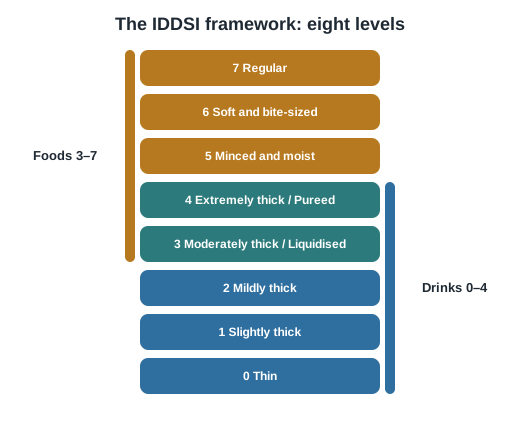
Food and drink textures are now described by the international IDDSI framework, eight levels from 0 to 7: drinks at levels 0–4 and foods at levels 3–7, with levels 3 and 4 shared. Know that a thickened liquid flows more slowly and gives time for airway closure, but increases residue when strength is poor, and that thickening does not replace treatment.
Key points
- Compensatory changes the path of the food; rehabilitative changes the mechanism.
- Name the physiological problem first, then choose the technique.
- Chin down for delayed onset; turn to the weak side for one-sided weakness; breath-hold for weak closure.
- Effort for the valleculae; Mendelsohn and Shaker for the UES.
- IDDSI: eight levels, drinks 0–4 and foods 3–7.
Summary table
| Technique | What it does | Who it suits |
|---|---|---|
| Chin tuck | Narrows the airway entrance and brings the tongue base closer to the pharyngeal wall | Delayed onset of the pharyngeal phase, weak tongue-base retraction |
| Head turn to the weak side | Shuts off the weak half of the pharynx so the bolus travels on the strong half; reduces pressure on the UES | One-sided pharyngeal weakness, for example after brainstem stroke |
| Supraglottic swallow | Holding the breath before the swallow and coughing straight after it | Incomplete vocal fold closure or delayed swallow onset |
| Effortful swallow | Increases tongue-base pressure | Vallecular residue |
| Mendelsohn manoeuvre | Voluntarily holds the larynx up at the peak of the swallow and prolongs UES opening | Weak laryngeal elevation and short UES opening |
| Shaker exercise (head lift) | Lying-down head lifts that strengthen the suprahyoid muscles | Inadequate UES opening and pyriform residue |
| IDDSI textures | Drinks 0 thin to 4 extremely thick; foods 3 liquidised to 7 regular | Thickened liquid for aspiration of thin liquids; soft or minced food for chewing problems |
In the full version for subscribers
- A simple algorithm
- Memory aid
- Exam traps
- 5 review cards
- What matters for the exam
The full version is open to subscribers of: Speech and hearing (communication disorders).
Subscriber? Read the full topic Plans and prices 25 free questions
Sources
- IDDSI Framework, version 2.0 (2019) — Complete IDDSI Framework detailed definitions
- ASHA Practice Portal, 2024 — Adult Dysphagia
- Logemann, Evaluation and Treatment of Swallowing Disorders, 2nd edition (1998) — Treatment procedures for oropharyngeal swallowing disorders
Sources are given for further reading; the text is written afresh and not copied from them.
Reviewed by the Examqo AI Professor · 2026-11-02. The text may contain errors; when in doubt, check the source.