Examqo › Examqo library › Speech-language pathology and audiology › Swallowing
The normal swallow and its phases
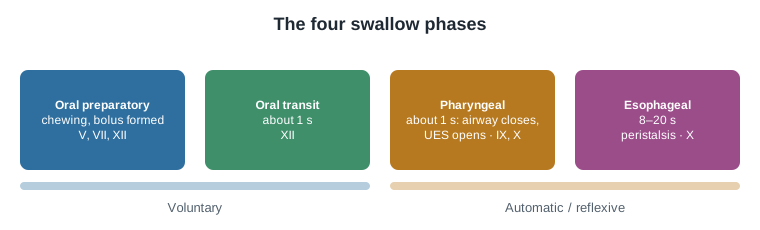
Swallowing is a sequence of four phases — oral preparatory, oral transit, pharyngeal and esophageal; the first two are voluntary, and the pharyngeal phase is a fast automatic response in which the airway closes and the upper esophageal sphincter opens.
Why it matters in the exam
Exam questions test three things: which phase is under voluntary control and which is automatic, which cranial nerves and muscles act in each phase, and the order of events in the pharyngeal phase. Distractors usually confuse closure of the nasopharynx by the soft palate with closure of the larynx, or opening of the upper esophageal sphincter (UES) with the esophageal peristaltic wave.
Knowing the normal swallow is the basis for every dysphagia question: when a stem describes vallecular residue, nasal regurgitation or airway penetration, you have to name which normal component failed. Candidates are also asked about the breath-hold during the swallow, swallowing changes with age (presbyphagia) and the anatomical differences in infants, whose larynx sits high and who suck, swallow and breathe in a fixed rhythm.
Key points
- Four phases: oral preparatory, oral transit, pharyngeal, esophageal.
- The first two are voluntary; the pharyngeal phase is automatic and lasts about a second.
- In the pharyngeal phase the palate seals, the larynx rises and moves forward, the airway closes and the UES opens.
- Airway protection builds from below upward and starts with the true vocal folds.
- Vallecular residue points to the tongue base; pyriform residue points to the UES and laryngeal elevation.
Summary table
| Phase | Control and duration | What happens | Key nerves |
|---|---|---|---|
| Oral preparatory | Voluntary; length depends on texture | Chewing, mixing with saliva and forming a bolus; lips sealed; the soft palate rests on the tongue base to stop early spill into the pharynx | V (chewing), VII (lips and cheeks), XII (tongue) |
| Oral transit | Voluntary; about one second | The tongue presses against the palate front to back and drives the bolus to the faucial arches and tongue base, where the pharyngeal phase starts | XII, V, VII |
| Pharyngeal | Automatic; about one second | The soft palate rises and seals the nasopharynx; hyoid and larynx move up and forward; the airway closes; the tongue base retracts and the constrictors contract; the UES opens; breathing stops | IX, X and the brainstem swallowing centre |
| Esophageal | Involuntary; 8–20 seconds | A peristaltic wave carries the bolus down the esophagus and the lower sphincter relaxes to let it into the stomach | X and the enteric nervous system |
| Airway protection (within the pharyngeal phase) | Automatic | Closure builds from below upward: true vocal folds first, then false folds and arytenoid approximation to the epiglottic base, then epiglottic inversion | X (recurrent and superior laryngeal nerves) |
In the full version for subscribers
- A simple algorithm
- Memory aid
- Exam traps
- 5 review cards
- What matters for the exam
The full version is open to subscribers of: Speech and hearing (communication disorders).
Subscriber? Read the full topic Plans and prices 25 free questions
Sources
- ASHA Practice Portal, 2024 — Adult Dysphagia
- Groher & Crary, Dysphagia: Clinical Management in Adults and Children, 3rd edition (2021) — Normal swallowing in adults
- Logemann, Evaluation and Treatment of Swallowing Disorders, 2nd edition (1998) — Anatomy and physiology of normal deglutition
Sources are given for further reading; the text is written afresh and not copied from them.
Reviewed by the Examqo AI Professor · 2026-11-02. The text may contain errors; when in doubt, check the source.