Examqo › Examqo library › Speech-language pathology and audiology › Voice and resonance
Laryngeal anatomy and voice physiology
Voice is produced when air pressure below the folds sets the pliable cover of the folds vibrating (the myoelastic-aerodynamic theory); pitch is set mainly by the mass, tension and length of the folds, and loudness mainly by subglottal pressure.
Why it matters in the exam
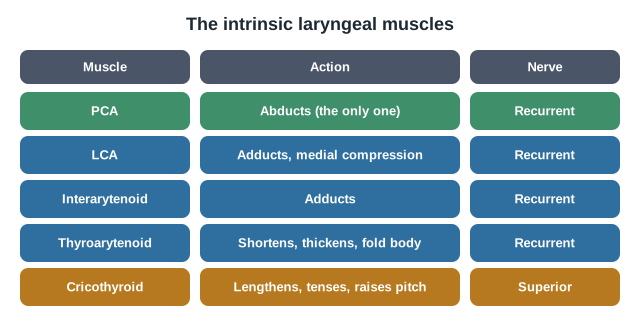
Questions in this area are factual and quick: which muscle abducts the folds (PCA, the only one), which muscles adduct (LCA and interarytenoid), which muscle lengthens and tenses (cricothyroid) and which forms the body of the fold (thyroarytenoid). Innervation is asked too: every intrinsic muscle gets its nerve supply from the vagus — the recurrent branch serves them all apart from the cricothyroid, whose supply comes from the superior laryngeal branch.
Another part concerns structure and function: the body-cover structure, in which Reinke's space in the cover matters most for the mucosal wave; the cricoid is the only complete cartilage ring; the epiglottis does not ossify with age; and changes across life — at maturation the larynx descends, boys have a large drop in pitch and girls a slight one, and in old age pitch rises in men and falls in women.
Key points
- PCA abducts; LCA and IA adduct; cricothyroid lengthens and tenses; thyroarytenoid shortens and thickens.
- All muscles are supplied by the recurrent nerve except the cricothyroid (superior nerve).
- Pitch: mass, tension and length; loudness: subglottal pressure.
- Reinke's space is essential for the mucosal wave.
- The cricoid is the only complete ring; the epiglottis does not ossify.
Summary table
| Structure or muscle | Role | Innervation or note |
|---|---|---|
| PCA (posterior cricoarytenoid) | The only muscle that abducts the folds (opening for breathing) | Recurrent nerve; bilateral paralysis closes the airway |
| LCA and interarytenoid | Adduct the folds and create medial compression | Recurrent nerve |
| Cricothyroid | Lengthens and tenses the folds and raises pitch | Superior laryngeal nerve, external branch |
| Thyroarytenoid (vocalis) | Shortens and thickens the fold; forms the body of the fold | Recurrent nerve |
| Body-cover structure | Cover: epithelium and Reinke's space, which vibrates in the mucosal wave; body: the vocalis muscle | A normal mucosal wave needs a soft, pliable cover |
| Cartilages | The cricoid is the only complete ring; thyroid, cricoid and arytenoids ossify with age, the epiglottis does not | The epiglottis is made of elastic cartilage |
| Voice across life | Maturation: the larynx descends; boys — large drop in pitch; girls — slight drop; old age — rise in men and fall in women | Average pitch: a man about 120 Hz, a woman about 200 Hz |
A free exam question
What is not true about the structure and function of the vocal folds?
- A. They are made of 5 layers
- B. Vocal fold vibration in phonation is caused by the speed of contraction of the laryngeal muscles
- C. During phonation the vocal folds are adducted
- D. The superficial layer of the lamina propria (SLP) is made of loose fibrous tissue like soft gelatin, and is called Reinke's space
In the full version for subscribers
- A simple algorithm
- Memory aid
- Exam traps
- 5 review cards
- What matters for the exam
The full version is open to subscribers of: Speech and hearing (communication disorders).
Subscriber? Read the full topic Plans and prices 25 free questions
Sources
- Colton, Casper & Leonard, Understanding Voice Problems, 4th edition (2011) — Anatomy and physiology of voice production
- Titze, Principles of Voice Production, 2nd edition (2000) — Vocal fold vibration and the myoelastic-aerodynamic theory
- Hirano, Clinical Examination of Voice, 1981 — The body-cover structure of the vocal fold
Sources are given for further reading; the text is written afresh and not copied from them.
Reviewed by the Examqo AI Professor · 2026-11-02. The text may contain errors; when in doubt, check the source.