Examqo › Examqo library › Speech-language pathology and audiology › Aphasia
Aphasia syndromes and classification
Aphasia is an acquired impairment of language; the classic syndromes are classified by three questions — is speech fluent, is comprehension preserved and is repetition preserved — and each combination has a name and a typical lesion site.
Why it matters in the exam
This is a central topic in the language section. Questions give an assessment summary — fluency, comprehension, repetition, naming — and ask for the aphasia type, or ask what is not a feature of a given type. Recurring examples: in Wernicke's aphasia comprehension is impaired and speech is fluent but empty; in conduction aphasia repetition is especially impaired; in transcortical aphasia repetition is relatively preserved; naming difficulty is present in almost all types.
It is also important to know what is not aphasia: right-sided weakness, dysarthria, dysphagia and depression do not indicate aphasia when no impairment of the language channels is described. You are also asked about agrammatism in Broca's aphasia — difficulty understanding and repeating sentences with non-canonical order, such as an object relative clause — and about subcortical aphasia in the thalamus and basal ganglia.
A good way to answer is to build a small table in your head: mark each of the three domains as intact or impaired, and only then choose a name. Many distractors are syndromes that fit two of the domains but not the third, so checking repetition is often the step that decides between two close options.
Key points
- Three questions: fluency, comprehension, repetition.
- Wernicke's: fluent, comprehension and repetition impaired; Broca's: nonfluent, comprehension relatively good, repetition impaired.
- Conduction: repetition very impaired; transcortical: repetition preserved.
- Naming difficulty is present in almost all aphasia types.
- Aphasia is a language impairment; weakness, dysarthria and depression alone are not aphasia.
Summary table
| Type | Fluency | Comprehension | Repetition |
|---|---|---|---|
| Broca's (expressive) | Nonfluent, agrammatic, effortful | Relatively good; difficulty with complex sentences | Impaired |
| Wernicke's (receptive) | Fluent, empty, paraphasias and neologisms, sometimes jargon and logorrhoea | Severely impaired | Impaired |
| Conduction | Fluent, phonological paraphasias and attempts at self-correction | Good | Very impaired relative to the rest |
| Global | Nonfluent, sometimes only automatic phrases | Severely impaired | Impaired |
| Transcortical motor | Nonfluent, difficulty initiating speech | Good | Preserved |
| Transcortical sensory | Fluent, echolalia | Impaired | Preserved |
| Anomic | Fluent with word-finding difficulty | Good | Preserved |
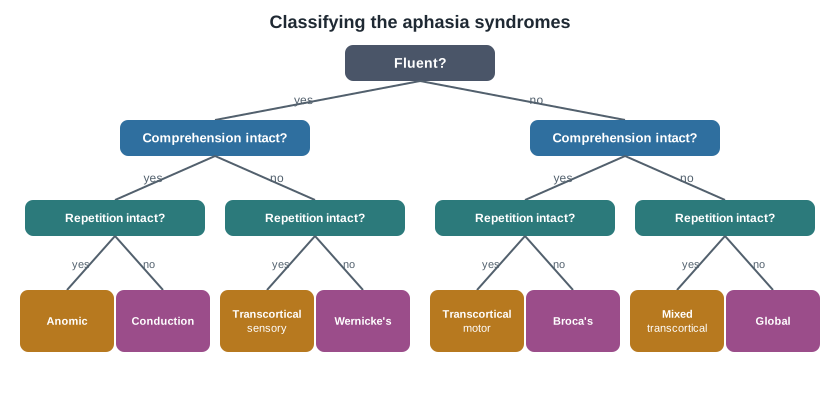
In the full version for subscribers
- A simple algorithm
- Memory aid
- Exam traps
- 5 review cards
- What matters for the exam
The full version is open to subscribers of: Speech and hearing (communication disorders).
Subscriber? Read the full topic Plans and prices 25 free questions
Sources
- Goodglass & Kaplan, Boston Diagnostic Aphasia Examination, 3rd edition (2001) — Aphasia syndromes and their classification
- Chapey (ed.), Language Intervention Strategies in Aphasia and Related Neurogenic Communication Disorders, 5th edition (2008) — Classification of the aphasias
- ASHA Practice Portal, 2024 — Aphasia
Sources are given for further reading; the text is written afresh and not copied from them.
Reviewed by the Examqo AI Professor · 2026-11-02. The text may contain errors; when in doubt, check the source.