Examqo › Examqo library › Speech-language pathology and audiology › Motor speech disorders
The dysarthria types (Mayo classification)
Dysarthria is a disorder of the motor execution of speech caused by nerve damage; each lesion site produces its own auditory "signature", and recognising the signature leads to the lesion site and the disease.
Why it matters in the exam
This is one of the most frequent topics in the motor section. The question describes a patient — disease, oral-mechanism findings and a description of speech — and asks for the dysarthria type, or describes a type and asks for the lesion site. The accepted classification is that of Darley, Aronson and Brown at the Mayo Clinic, originally built on listeners' ratings of speech in neurological patients.
You should also know the difference between lower motor neuron damage (atrophy and fasciculations) and upper motor neuron damage (spasticity and brisk reflexes), and the mixed types: ALS combines flaccid and spastic components, multiple sclerosis combines spastic and ataxic, and PSP combines hypokinetic and spastic. Dysarthria affects several subsystems — respiration, phonation, resonance, articulation and prosody — and not language.
Key points
- Dysarthria = impaired motor execution from nerve damage, across several subsystems.
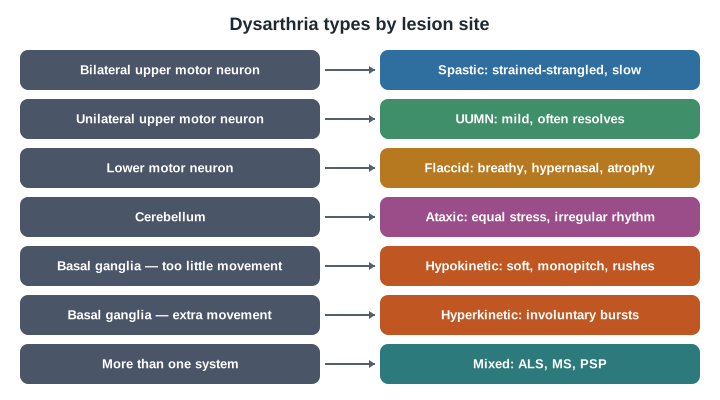
- Flaccid: lower motor neuron; spastic: bilateral upper motor neuron; ataxic: cerebellum.
- Hypokinetic: Parkinson's disease; hyperkinetic: involuntary movements as in Huntington's disease.
- ALS flaccid-spastic, multiple sclerosis spastic-ataxic, PSP hypokinetic-spastic.
- The Mayo classification was built by listening to patients' speech.
Summary table
| Type | Lesion site | Prominent speech features | Examples |
|---|---|---|---|
| Flaccid | Lower motor neuron: cranial or spinal nerve, neuromuscular junction or muscle | Hypernasality, breathy voice, imprecise articulation; weakness, atrophy and fasciculations | Nerve palsy, myasthenia, Guillain-Barre |
| Spastic | Upper motor neuron on both sides | Strained-strangled voice, slow rate, low pitch, hypernasality; unregulated crying or laughing | Bilateral strokes, head injury |
| Ataxic | Cerebellum | Irregular articulatory breakdowns, excess and equal stress on every syllable, irregular rhythm in fast syllable repetition | Cerebellar stroke, multiple sclerosis, alcohol |
| Hypokinetic | Basal ganglia (dopamine pathway) | Soft voice, monopitch, short rushes of speech, syllable repetitions, inappropriate silences | Parkinson's disease |
| Hyperkinetic | Basal ganglia | Involuntary movements that disrupt speech: sudden bursts, forced breaths, voice tremor | Huntington's disease, dystonia, tardive dyskinesia, essential tremor |
| Unilateral upper motor neuron (UUMN) | Upper motor neuron on one side | Mild imprecise articulation, weakness of the lower face and tongue on the opposite side; usually resolves | One-sided stroke |
| Mixed | More than one system | A combination of two or more types | ALS: flaccid-spastic; multiple sclerosis: spastic-ataxic; PSP: hypokinetic-spastic |
A free exam question
The Mayo Clinic classification of the dysarthrias (Darley, Aronson and Brown) was originally based on:
- A. Acoustic measures of formants in healthy speakers
- B. Brain imaging of the lesion site in each patient
- C. Listeners' ratings of speech in neurological patients
- D. Patients' own reports of the difficulties they felt
In the full version for subscribers
- A simple algorithm
- Memory aid
- Exam traps
- 5 review cards
- What matters for the exam
The full version is open to subscribers of: Speech and hearing (communication disorders).
Subscriber? Read the full topic Plans and prices 25 free questions
Sources
- Duffy, Motor Speech Disorders: Substrates, Differential Diagnosis, and Management, 4th edition (2020) — The dysarthrias: classification and lesion sites
- Darley, Aronson & Brown, Motor Speech Disorders, 1975 — Perceptual classification of the dysarthrias
- ASHA Practice Portal, 2024 — Dysarthria in Adults
Sources are given for further reading; the text is written afresh and not copied from them.
Reviewed by the Examqo AI Professor · 2026-11-02. The text may contain errors; when in doubt, check the source.