Examqo › Examqo library › Speech-language pathology and audiology › Hearing science
Outer and middle ear physiology: resonance, impedance matching and the middle-ear muscles
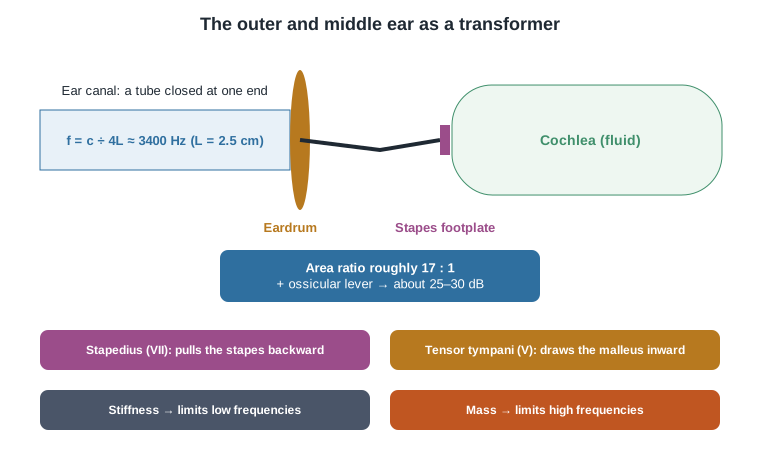
The outer ear boosts the 2–4 kHz region and supplies direction cues, and the middle ear solves the air-to-fluid problem: without it most of the energy would bounce back. Stiffness mainly limits the low frequencies and mass mainly the high ones — which explains most conductive patterns on the audiogram and in tympanometry.
Why it matters in the exam
The bank asks for calculations and directions: the ear canal is a tube closed at one end, so its first resonance is the speed of sound over 4 times the canal length — about 3400 Hz for a 2.5 cm canal; an infant's canal is shorter and resonates higher. The main impedance-matching mechanism is how much larger the vibrating eardrum is than the stapes footplate (roughly 17 to 1), with the ossicular lever adding a little; together they recover some 25–30 dB that would otherwise be lost.
The second part is the middle-ear muscles. The stapedius is supplied by the facial nerve (VII), pulls the stapes backward, stiffens the ossicular chain and lowers admittance — so it underlies the acoustic reflex. The tensor tympani is supplied by the mandibular branch of the trigeminal nerve (V) and draws the malleus and eardrum inward. Roles of the reflex: protection from loud low-frequency sound (not from impulses, because it is slow), damping self-generated sounds, and better hearing in low-frequency noise. The Eustachian tube stays shut most of the time and opens on swallowing and yawning through the tensor veli palatini; in children it is shorter and more horizontal.
Key points
- Ear canal: a tube closed at one end, resonance around 3 kHz.
- Impedance matching: mainly an area ratio of roughly 17 to 1.
- Stiffness hurts the lows, mass the highs.
- Stapedius — VII, backward, reflex; tensor tympani — V, inward.
- The tube stays shut except on swallowing; short and horizontal in children.
Summary table
| Structure or principle | What it does | What the exam asks |
|---|---|---|
| Pinna and concha | Spectral cues for elevation and front versus back | Vertical localisation relies on these cues, not on time and level differences |
| Ear canal | Resonates as a tube closed at one end, peak around 2.5–3 kHz | f = c ÷ 4L; higher resonance in infants; about 10–20 dB added near the eardrum |
| Area ratio | Large eardrum versus small footplate, roughly 17 to 1 | The main mechanism of impedance matching |
| Stiffness versus mass | Stiffness limits low frequencies; mass limits high frequencies | Early otosclerosis — lows; fluid or added mass — highs |
| Stapedius | Nerve VII; pulls the stapes backward and stiffens the chain | Basis of the acoustic reflex; a facial lesion above its branch abolishes it |
| Tensor tympani | Nerve V; draws the malleus and eardrum inward | In humans it adds little to the reflex to sound |
| Eustachian tube | Ventilation, pressure equalisation and drainage; opens on swallowing | Closed at rest; short and horizontal in children — prone to otitis |
In the full version for subscribers
- A simple algorithm
- Memory aid
- Exam traps
- 5 review cards
- What matters for the exam
The full version is open to subscribers of: Speech and hearing (communication disorders).
Subscriber? Read the full topic Plans and prices 25 free questions
Sources
- Pickles, An Introduction to the Physiology of Hearing, 4th edition (2012) — The outer and middle ear
- Katz (ed.), Handbook of Clinical Audiology, 7th edition (2015) — Anatomy and physiology of the auditory system
- ANSI/ASA S3.6, 2018 — Specification for Audiometers (reference thresholds by transducer)
Sources are given for further reading; the text is written afresh and not copied from them.
Reviewed by the Examqo AI Professor · 2026-11-02. The text may contain errors; when in doubt, check the source.