Examqo › Examqo library › Speech-language pathology and audiology › Hearing rehabilitation
Hearing aid signal processing: gain, compression, WDRC, expansion, directionality and frequency lowering
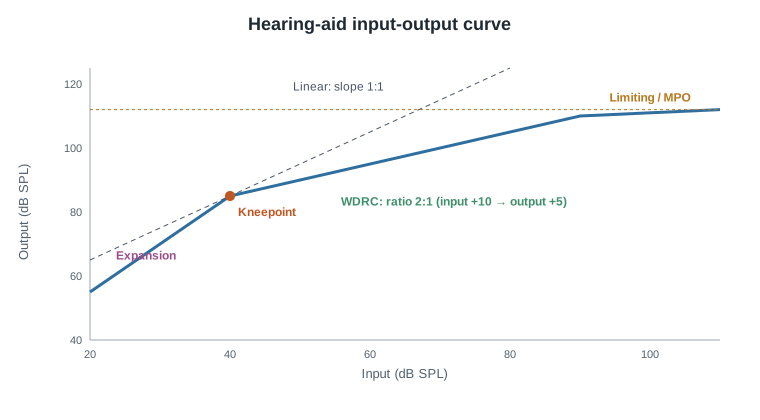
A modern hearing aid is not just an amplifier: it gives different gain to soft and loud sounds (compression), keeps output below discomfort, quiets internal noise in silence, favours sound from the front and moves high-frequency information to a region that can hear it. The input-output curve sums up most of this.
Why it matters in the exam
Definitions: gain is output minus input in dB SPL. In linear amplification gain is the same at every input level (a 1:1 slope) up to the ceiling. The kneepoint, also called the compression threshold, marks where gain begins to drop as input rises. To get the compression ratio, divide how much the input changed by how much the output changed — a 10 dB rise in input with 5 in output is 2:1. If gain is added only for loud inputs, the ratio falls (closer to linear); if soft inputs get more and loud inputs less — the ratio rises. WDRC — a low threshold and a low ratio: soft sounds get more gain than medium and loud ones, so the wide range of speech is squeezed into the narrow dynamic range of an ear with recruitment. Compression limiting — a high threshold and a very high ratio, to keep output below the UCL without the distortion of peak clipping. At the MPO the output rises no further. Expansion works below the kneepoint and lowers gain for very soft input — against the aid's "hiss" in quiet.
Digital: the sampling rate must be at least 2 times the highest frequency to be represented (Nyquist); frequencies above half the sampling rate produce aliasing, so there is an anti-aliasing filter. A directional microphone picks up frontal sound better than sound from elsewhere, which helps the SNR whenever the talker faces the listener; it attenuates talkers behind (a student who hears the lecturer but not the questioners behind him). An adaptive directional microphone chooses between omnidirectional and directional modes and steers its null toward the noise source. For young children an omnidirectional setting is often preferred to allow incidental learning. Turning the volume down does not improve the signal-to-noise ratio. Frequency lowering (compression or transposition) moves high-frequency information such as /s/ to a region with residual hearing. No aid repairs broadened auditory filters. Links between two aids synchronise programs and volume and can send sound from side to side; data logging shows hours of use and listening environments.
Key points
- Gain = output minus input; linear = slope 1.
- Ratio = Δinput ÷ Δoutput; WDRC with low threshold and ratio.
- Compression limiting and MPO from the UCL.
- Expansion against hiss; Nyquist: 2 times the highest frequency.
- Directionality improves SNR in front; frequency lowering for /s/.
Summary table
| Concept | Definition | What it does in practice |
|---|---|---|
| Gain and input-output curve | Output minus input; output plotted against input | Slope 1 — linear; a smaller slope — compression |
| Kneepoint and ratio | Compression threshold; change in input ÷ change in output | 10 in for 5 out = 2:1 |
| WDRC | Low threshold, low ratio | Soft sounds audible, loud ones not annoying |
| Compression limiting and MPO | High threshold, high ratio; the output ceiling | Set from the UCL; less distortion than clipping |
| Expansion | Less gain for very soft input | Hides internal hiss in quiet |
| Sampling | At least 2 times the highest frequency; aliasing above half the rate | A higher rate — wider bandwidth |
| Directionality and frequency lowering | Favours the front; moves highs down | Better SNR in front; /s/ made accessible |
In the full version for subscribers
- A simple algorithm
- Memory aid
- Exam traps
- 5 review cards
- What matters for the exam
The full version is open to subscribers of: Speech and hearing (communication disorders).
Subscriber? Read the full topic Plans and prices 25 free questions
Sources
- Dillon, Hearing Aids, 2nd edition (2012) — Compression systems; directional microphones and arrays; advanced signal processing
- Kates, Digital Hearing Aids, 2008 — Sampling, filter banks and feedback cancellation
- Simpson, Trends in Amplification, 2009 — Frequency-lowering devices for managing high-frequency hearing loss
Sources are given for further reading; the text is written afresh and not copied from them.
Reviewed by the Examqo AI Professor · 2026-11-02. The text may contain errors; when in doubt, check the source.