Examqo › Examqo library › Speech-language pathology and audiology › Hearing rehabilitation
Hearing aid components, styles, earmoulds and acoustic modifications
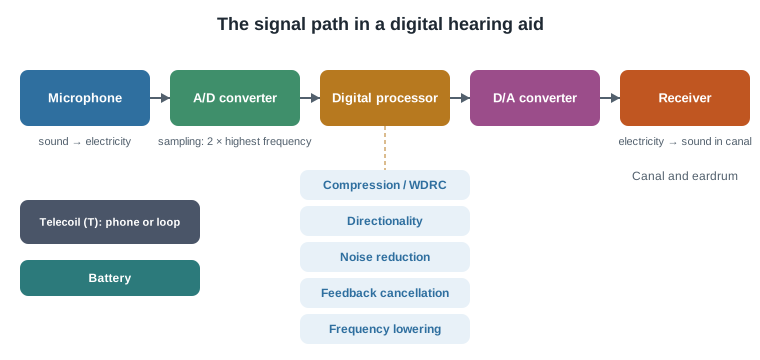
A hearing aid turns sound into an electrical signal (microphone), amplifies and processes it (amplifier and processor), and turns it back into sound in the canal (the receiver). What happens between the receiver and the eardrum — mould, vent, tubing and insertion depth — shapes the response as much as the processor does.
Why it matters in the exam
Components: the microphone converts acoustic energy to electrical — the smaller it is, the higher its resonance; the amplifier and processor add gain; the receiver gives back an acoustic signal; the telecoil (T) picks up an electromagnetic field from a phone or an induction loop. In T mode the microphone is off or reduced, so a child switched to T by mistake does not hear the teacher and hears a hum near electrical equipment. Styles: BTE and RIC behind the ear; ITE, ITC and CIC in the ear. A CIC sits deep, with its microphone at the canal entrance, so it uses the pinna effect; deep insertion leaves a small volume in front of the eardrum, so the same output gives a higher SPL.
Sealing the canal removes its natural resonance (about 15–20 dB around 2.5–3 kHz) — this is insertion loss, and the aid must make up for it. The occlusion effect: one's own voice sounds "hollow" or "in a barrel" and chewing is loud, because low-frequency bone-conducted energy is trapped in the canal. Fixes: a vent (an opening that releases the lows and lowers their gain), an open fit, or deep insertion. A larger vent — less low-frequency gain and more risk of feedback. Feedback (whistling) arises when amplified sound escapes the canal and reaches the microphone again: a loose mould, wax blocking the canal and reflecting the sound, cracked tubing or high gain; the most effective fix is active feedback cancellation. A full shell mould gives the best seal — suited to a severe flat loss; a skeleton mould keeps a retention ring with less seal; an open fit suits a high-frequency-only loss. Dampers in the tubing smooth its resonance peaks.
Key points
- Microphone, amplifier-processor, receiver, battery, telecoil.
- CIC: pinna effect, small volume, higher SPL.
- Insertion loss: about 15–20 dB around 2.5–3 kHz.
- Occlusion — vent, open fit, deep insertion.
- Feedback — leakage to the microphone; active feedback cancellation.
Summary table
| Component or change | What it does | What is asked |
|---|---|---|
| Microphone | Sound to electricity | Smaller — higher resonance |
| Amplifier and processor | Add gain and process | The part that amplifies weak signals |
| Telecoil (T) | Picks up a field from a phone or loop | In T the microphone is off; hum near electrical equipment |
| CIC and deep insertion | Microphone at the canal entrance; small residual volume | Pinna effect; more SPL; less occlusion |
| Vent | Releases lows; equalises pressure | Larger — fewer lows, more feedback |
| Earmoulds | Full shell — maximal seal; skeleton — retention ring; open — no seal | Severe flat — full shell; highs only — open |
| Dampers | Smooth tubing resonance peaks | Fewer mid-frequency peaks |
In the full version for subscribers
- A simple algorithm
- Memory aid
- Exam traps
- 5 review cards
- What matters for the exam
The full version is open to subscribers of: Speech and hearing (communication disorders).
Subscriber? Read the full topic Plans and prices 25 free questions
Sources
- Dillon, Hearing Aids, 2nd edition (2012) — Hearing aid components; earmolds, earshells and coupling systems
- ANSI/ASA S3.22, 2014 — Specification of Hearing Aid Characteristics
- Taylor & Mueller, Fitting and Dispensing Hearing Aids, 3rd edition (2021) — Earmolds and acoustic modifications
Sources are given for further reading; the text is written afresh and not copied from them.
Reviewed by the Examqo AI Professor · 2026-11-02. The text may contain errors; when in doubt, check the source.