Examqo › Examqo library › Internal medicine › Pulmonology · IMLE
Pleural effusion
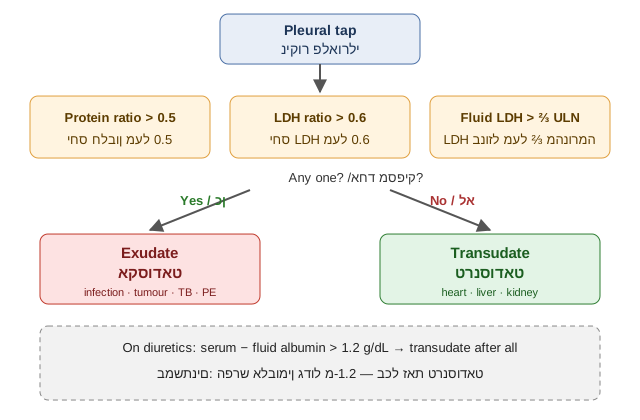
The first step is to separate a transudate (a pressure problem — heart, liver, kidney) from an exudate (a problem of the pleura itself — infection, tumour, inflammation) using Light's criteria, and then to look for the cause in the fluid.
Why it matters in the exam
Exam questions almost always present the results of a pleural tap and ask for their interpretation. The three Light's criteria must be remembered — one positive criterion is enough to call an exudate — together with the trap of the heart-failure patient on diuretics: the fluid "looks" exudative, and the serum-to-fluid albumin gradient (above 1.2 g/dL) then proves it is a transudate after all. In bilateral effusions in a patient with known heart failure and a typical picture, diuretics come first rather than an immediate tap.
The second theme is the parapneumonic effusion: pH below 7.2, low glucose or pus on aspiration call for a chest drain, not antibiotics alone. Other fluid findings point to the diagnosis: lymphocytes with a high ADA — tuberculosis; very low glucose — rheumatoid arthritis, empyema, tuberculosis or tumour; high amylase — pancreatitis or oesophageal rupture; triglycerides above 110 mg/dL — chylothorax; a fluid haematocrit above half of the blood value — haemothorax. In a recurrent malignant effusion, the choice is between talc pleurodesis and an indwelling pleural catheter.
Key points
- Light's criteria: protein above 0.5, LDH above 0.6, fluid LDH above two thirds of the upper limit.
- One positive criterion is enough for an exudate; on diuretics check the albumin gradient (above 1.2 g/dL = transudate).
- pH below 7.2 or pus in a parapneumonic effusion → chest drain.
- ADA above 40 U/L with lymphocytes points to tuberculosis; triglycerides above 110 mg/dL to chylothorax.
- Recurrent malignant effusion: talc pleurodesis or an indwelling pleural catheter.
Summary table
| Fluid test | Value | Meaning | Action |
|---|---|---|---|
| Fluid/serum protein | Above 0.5 | Exudate (Light's criterion) | Look for a local cause |
| Fluid/serum LDH | Above 0.6, or fluid LDH above two thirds of the serum upper limit | Exudate (Light's criterion) | Culture, cytology, ADA |
| Serum-fluid albumin gradient | Above 1.2 g/dL | Transudate despite Light's (diuretics) | Treat the underlying disease |
| pH in a parapneumonic effusion | Below 7.2, or pus | Complicated effusion or empyema | Chest drain + antibiotics |
| ADA and lymphocytes | ADA above 40 U/L with lymphocytosis | Tuberculous pleurisy | Pleural biopsy for confirmation and culture |
| Triglycerides | Above 110 mg/dL | Chylothorax | Look for thoracic duct injury or lymphoma |
In the full version for subscribers
- A simple algorithm
- Memory aid
- Exam traps
- 5 review cards
- Enough for IMLE
The full version is open to subscribers of: Medical licensing exam (IMLE), Internal medicine, Emergency medicine, Cardiothoracic surgery, Dermatology and venereology, Forensic medicine, Geriatrics, Oncology, Diagnostic pathology, Pediatric surgery, Diagnostic radiology, Vascular surgery.
Subscriber? Read the full topic Plans and prices 25 free questions
Sources
- British Thoracic Society Guideline for Pleural Disease, 2023 — Investigation of a unilateral pleural effusion; pleural infection; malignant pleural effusion
- Harrison's Principles of Internal Medicine, 21st edition (2022) — Disorders of the Pleura
Sources are given for further reading; the text is written afresh and not copied from them.
Reviewed by the Examqo AI Professor · 2026-11-02. The text may contain errors; when in doubt, check the source.