Examqo › Examqo library › Internal medicine · Cardiology
ST-elevation myocardial infarction (STEMI)
In STEMI the artery is occluded and muscle dies with every minute: the aim is fast reopening — primary PCI within 120 minutes of first medical contact, or, if that is impossible, fibrinolysis within 10 minutes of diagnosis.
Why it matters in the exam
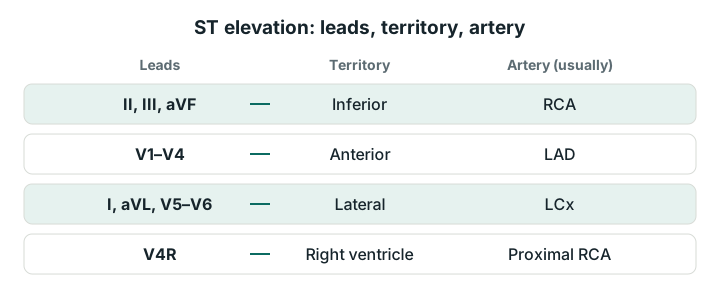
This is one of the most examined topics: reading the ECG (which leads are elevated and what that says about the artery), choosing between primary PCI and fibrinolysis by time, the first drugs and their doses, and special situations such as an inferior infarct with right-ventricular involvement. Many questions are about complications by timing: arrhythmias in the first hours, rupture of a papillary muscle or of the septum in the first days, free-wall rupture, left-ventricular aneurysm and Dressler syndrome weeks later.
Later treatment is also examined: dual antiplatelet therapy for 12 months, a high-intensity statin, a beta-blocker and an ACE inhibitor when LV function is reduced, and cardiac rehabilitation. Another common question is when it is still worth opening the artery after more than 12 hours: yes with ongoing pain, instability or arrhythmia, and not in an asymptomatic patient more than 48 hours from onset.
Key points
- STEMI = ST elevation in two contiguous leads, with different thresholds in V2–V3 by sex and age.
- Primary PCI within 120 minutes of first contact; otherwise fibrinolysis within 10 minutes.
- After fibrinolysis: rescue PCI if the ST has not fallen by 50%, and routine angiography within 2–24 hours.
- First treatment: aspirin, a potent P2Y12 inhibitor and heparin; oxygen only for hypoxaemia.
- Mechanical complications on days 2–7: septal rupture, papillary muscle rupture and free-wall rupture.
Summary table
| Item | Criterion | Action | Numbers to remember |
|---|---|---|---|
| ECG diagnosis | ST elevation in two contiguous leads | Primary PCI | 1 mm or more; in V2–V3 at least 2.5 mm in men under 40, 2 mm in men over 40, 1.5 mm in women |
| Primary PCI | Symptoms for less than 12 hours and rapid access | PCI of the culprit artery | Within 120 minutes of first contact |
| Fibrinolysis | No PCI available within 120 minutes | Tenecteplase, then transfer for angiography | Within 10 minutes of diagnosis; angiography after 2–24 hours |
| First drugs | Every patient without a contraindication | Aspirin, a P2Y12 inhibitor (prasugrel or ticagrelor), heparin | Aspirin 150–300 mg; prasugrel 60 mg; ticagrelor 180 mg |
| Right-ventricular infarct | Inferior infarct with hypotension and clear lungs | Right-sided leads (V4R), fluids | No nitrates |
| Mechanical complications | New murmur or shock on days 2–7 | Urgent echocardiogram and surgery | Septal rupture, papillary muscle rupture, free-wall rupture |
In the full version for subscribers
- A simple algorithm
- Memory aid
- Exam traps
- 5 review cards
- Enough for IMLE
The full version is open to subscribers of: Medical licensing exam (IMLE), Internal medicine, Emergency medicine, Family medicine.
Subscriber? Read the full topic Plans and prices 25 free questions
Sources
- ESC Guidelines for the management of acute coronary syndromes, 2023 — ST-segment elevation myocardial infarction: reperfusion strategy
- Fourth Universal Definition of Myocardial Infarction (ESC/ACC/AHA/WHF), 2018 — ECG criteria for ST elevation
- Harrison's Principles of Internal Medicine, 21st edition (2022) — ST-Segment Elevation Myocardial Infarction
Sources are given for further reading; the text is written afresh and not copied from them.
Reviewed by the Examqo AI Professor · 2026-11-02. The text may contain errors; when in doubt, check the source.