Examqo › Examqo library › Internal medicine · Cardiology
Chronic heart failure
Survival in HFrEF rests on four pillars — ARNI or ACEi, a beta-blocker, an MRA and an SGLT2 inhibitor — while diuretics only relieve congestion.
Why it matters in the exam
Exam questions almost always start from the ejection fraction: the EF number sets the category and the treatment. Candidates are asked which drug lowers mortality and which only improves symptoms (furosemide, digoxin), when to add an ICD or CRT, and which drugs must be avoided (verapamil, diltiazem, NSAIDs, thiazolidinediones). Case questions also test potassium and creatinine monitoring after starting an MRA, the 36-hour gap when switching an ACE inhibitor to sacubitril/valsartan, and the treatment of iron deficiency. In HFpEF the usual question is what has been proven besides diuretics, and the answer is an SGLT2 inhibitor.
The first step in every case is the diagnosis: breathlessness, oedema and fatigue are not enough on their own, and both laboratory evidence (NT-proBNP) and structural evidence on echocardiography are needed. Then a correctable cause is sought — coronary disease, valve disease, hypertension, fast atrial fibrillation, alcohol or cardiotoxic drugs — and in parallel the full drug treatment is started, without waiting for one drug to reach its maximal dose before the next is added.
Key points
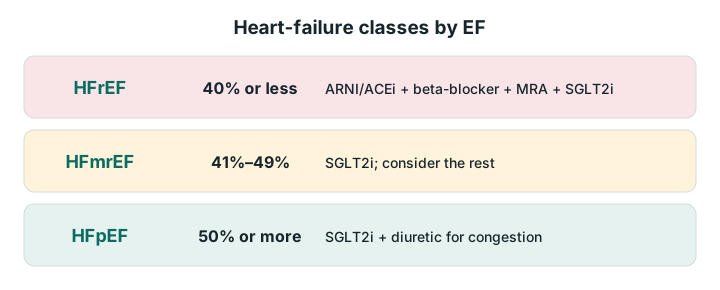
- HFrEF = EF 40% or less; HFmrEF = 41%–49%; HFpEF = 50% or more.
- The four mortality-reducing pillars in HFrEF: ARNI/ACEi, beta-blocker, MRA and SGLT2 inhibitor.
- Loop diuretics and digoxin relieve symptoms only and do not prolong life.
- ICD when the EF stays at 35% or less after 3 months; CRT when there is also LBBB with a QRS of 150 ms or more.
- In HFpEF the proven drug is an SGLT2 inhibitor, alongside diuretics and treatment of comorbidities.
Summary table
| Type | Definition (EF) | Treatment that reduces death or admissions | Exam notes |
|---|---|---|---|
| HFrEF | 40% or less | ARNI/ACEi/ARB + beta-blocker + MRA + SGLT2 inhibitor | Start all four early at low doses, then up-titrate |
| HFmrEF | 41%–49% | SGLT2 inhibitor; ARNI/ACEi, beta-blocker and MRA may be considered | Behaves like HFrEF, especially at the lower end of the range |
| HFpEF | 50% or more, with structural disease or raised filling pressures | SGLT2 inhibitor (dapagliflozin or empagliflozin) | Diuretics for congestion; control blood pressure and atrial fibrillation |
| Devices | EF 35% or less after 3 months of optimal therapy | Primary-prevention ICD; CRT if QRS 150 ms or more with LBBB | Not within 40 days of a myocardial infarction |
| Iron deficiency | Ferritin below 100, or 100–299 with TSAT below 20% | Intravenous iron (ferric carboxymaltose) | Improves symptoms and reduces admissions even without anaemia |
In the full version for subscribers
- A simple algorithm
- Memory aid
- Exam traps
- 5 review cards
- Enough for IMLE
The full version is open to subscribers of: Medical licensing exam (IMLE), Internal medicine, Family medicine, Geriatrics.
Subscriber? Read the full topic Plans and prices 25 free questions
Sources
- ESC Guidelines for the diagnosis and treatment of acute and chronic heart failure, 2021, with the 2023 focused update — Chronic heart failure with reduced, mildly reduced and preserved ejection fraction
- AHA/ACC/HFSA Guideline for the Management of Heart Failure, 2022 — Stage C HFrEF: guideline-directed medical therapy
- Harrison's Principles of Internal Medicine, 21st edition (2022) — Heart Failure: Management
Sources are given for further reading; the text is written afresh and not copied from them.
Reviewed by the Examqo AI Professor · 2026-11-02. The text may contain errors; when in doubt, check the source.