Examqo › Examqo library › Internal medicine › Nephrology and electrolytes · IMLE
Chronic kidney disease (CKD)
CKD is kidney damage lasting more than 3 months, classified by eGFR and albuminuria, and slowed mainly with an ACEi or ARB, an SGLT2 inhibitor and blood-pressure control — while its complications are treated: anaemia, bone-mineral disease, acidosis and hyperkalaemia.
Why it matters in the exam
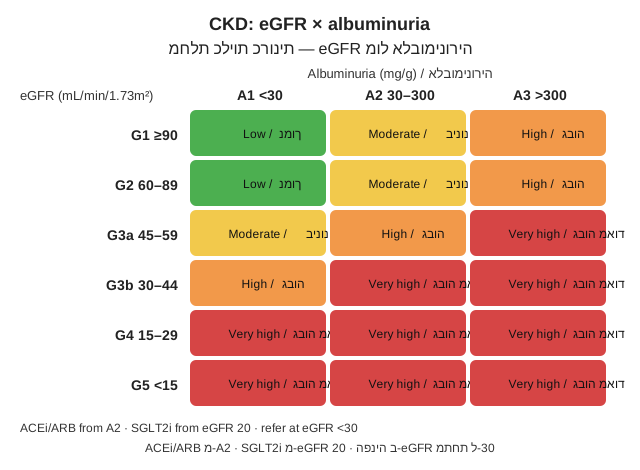
CKD questions first test classification: G stages by eGFR (G3a 45–59, G3b 30–44, G4 15–29, G5 below 15) and A stages by albuminuria (A2 30–300 mg/g, A3 above 300). Then come the drugs that slow progression: an ACEi or ARB in every patient with albuminuria, an SGLT2 inhibitor from an eGFR of 20 and above (also without diabetes), and finerenone in type 2 diabetes with albuminuria despite an ACEi. A standard distractor is combining an ACEi with an ARB — not allowed, since it increases hyperkalaemia and AKI without benefit.
Complications are the second part. In bone-mineral disease (CKD-MBD) phosphate is high, calcium low, PTH high and active vitamin D (calcitriol) deficient, so phosphate is lowered with diet and binders. In anaemia iron is replaced first, and only then is an ESA considered, without aiming for a haemoglobin above 11.5 g/dL because that raises the risk of stroke. Drug adjustments must also be remembered: metformin — reduce the dose at eGFR 30–44 and stop below 30; avoid NSAIDs. The decision to start dialysis rests on symptoms and complications, not on an eGFR number alone, and referral to a nephrologist comes earlier, usually at an eGFR below 30.
Key points
- CKD: eGFR below 60 or albuminuria 30 mg/g or more for more than 3 months.
- Slowing: ACEi or ARB with albuminuria, SGLT2 inhibitor from eGFR 20, finerenone in diabetes with albuminuria.
- CKD-MBD: high phosphate, low calcium, high PTH.
- Anaemia: iron first, ESA when Hb is below 10, not above 11.5 g/dL.
- Metformin: reduce at eGFR 30–44, stop below 30.
Summary table
| Topic | Value / criterion | Treatment | Exam note |
|---|---|---|---|
| Definition | eGFR below 60 or albuminuria 30 mg/g or more, for over 3 months | Find the cause (diabetes, hypertension, glomerular) | Stages G1–G5 and A1–A3 |
| Slowing progression | Albuminuria A2–A3 | ACEi or ARB at the maximum tolerated dose | Do not combine an ACEi with an ARB |
| SGLT2 inhibitor | eGFR 20 or more | Dapagliflozin or empagliflozin | Protects the kidney even without diabetes |
| Blood pressure | Systolic below 120 if tolerated (KDIGO) | ACEi/ARB, diuretic, calcium-channel blocker | A small rise in creatinine when starting an ACEi is expected |
| CKD-MBD | High phosphate, low calcium, high PTH | Phosphate restriction, phosphate binders, vitamin D | Secondary hyperparathyroidism |
| Anaemia | Low Hb, usually normocytic | Iron first; ESA when Hb is below 10 | Do not aim for Hb above 11.5 g/dL |
In the full version for subscribers
- A simple algorithm
- Memory aid
- Exam traps
- 5 review cards
- Enough for IMLE
The full version is open to subscribers of: Medical licensing exam (IMLE), Internal medicine, Family medicine, Geriatrics, Anesthesiology, Dermatology and venereology, Nuclear medicine, Occupational medicine, Ophthalmology, Diagnostic pathology, Urology, Vascular surgery, Neurology.
Subscriber? Read the full topic Plans and prices 25 free questions
Sources
- KDIGO Clinical Practice Guideline for the Evaluation and Management of Chronic Kidney Disease, 2024 — Definition, GFR and albuminuria categories, slowing progression and complications
- KDIGO Clinical Practice Guideline for Diabetes Management in CKD, 2022 — SGLT2 inhibitors, finerenone and metformin dosing
- Harrison's Principles of Internal Medicine, 21st edition (2022) — Chronic Kidney Disease
Sources are given for further reading; the text is written afresh and not copied from them.
Reviewed by the Examqo AI Professor · 2026-11-02. The text may contain errors; when in doubt, check the source.